Deck Types
EstimateQuest supports three estimation scales. The deck type is chosen when creating a session and cannot be changed once the session starts.
Fibonacci
Section titled “Fibonacci”1, 2, 3, 5, 8, 13, 21, ? +
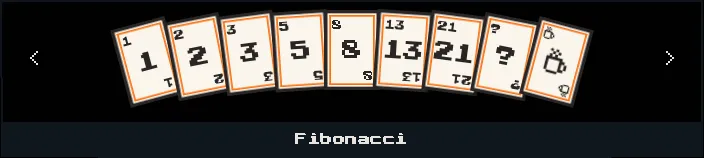
The most popular Planning Poker scale. Based on the Fibonacci sequence, the gaps between values grow as estimates increase. This reflects real-world estimation uncertainty — you can confidently distinguish a “3” from a “5”, but the difference between “18” and “21” is meaningless at that scale.
The card is unique to the Fibonacci deck and signals “I need a break.”
Best for: teams comfortable with relative sizing who want nuanced differentiation between small and medium items.
Linear
Section titled “Linear”1, 2, 3, 4, 5, 6, 7, 8, 9, 10, ?
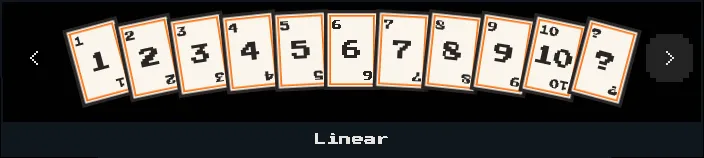
A straightforward 1–10 scale. Every value is equally spaced, making it simpler to understand and communicate.
Best for: teams new to Planning Poker, or when estimates map directly to hours/days.
T-Shirt
Section titled “T-Shirt”XS, S, M, L, XL, XXL, ?

Relative sizing without numbers. T-Shirt sizing is deliberately imprecise — it encourages thinking in “buckets” rather than exact values.
Best for: early-stage estimation, epic-level sizing, or teams who find number scales too granular.
The ? Card
Section titled “The Card”Available in all three decks, the ? card means “I don’t have enough information to estimate this ticket.” It signals to the moderator that more context or discussion is needed.
? votes are excluded from statistics — they don’t affect the average, median, or mode calculations.
Choosing a Deck
Section titled “Choosing a Deck”| Consideration | Fibonacci | Linear | T-Shirt |
|---|---|---|---|
| Precision | High | Medium | Low |
| Range | 1–21 | 1–10 | XS–XXL |
| Learning curve | Low | Lowest | Lowest |
| Special cards | ? , | ? | ? |
| Best for | Most teams | Simple estimation | Rough sizing |
When in doubt, go with Fibonacci. It’s the industry standard for a reason.